
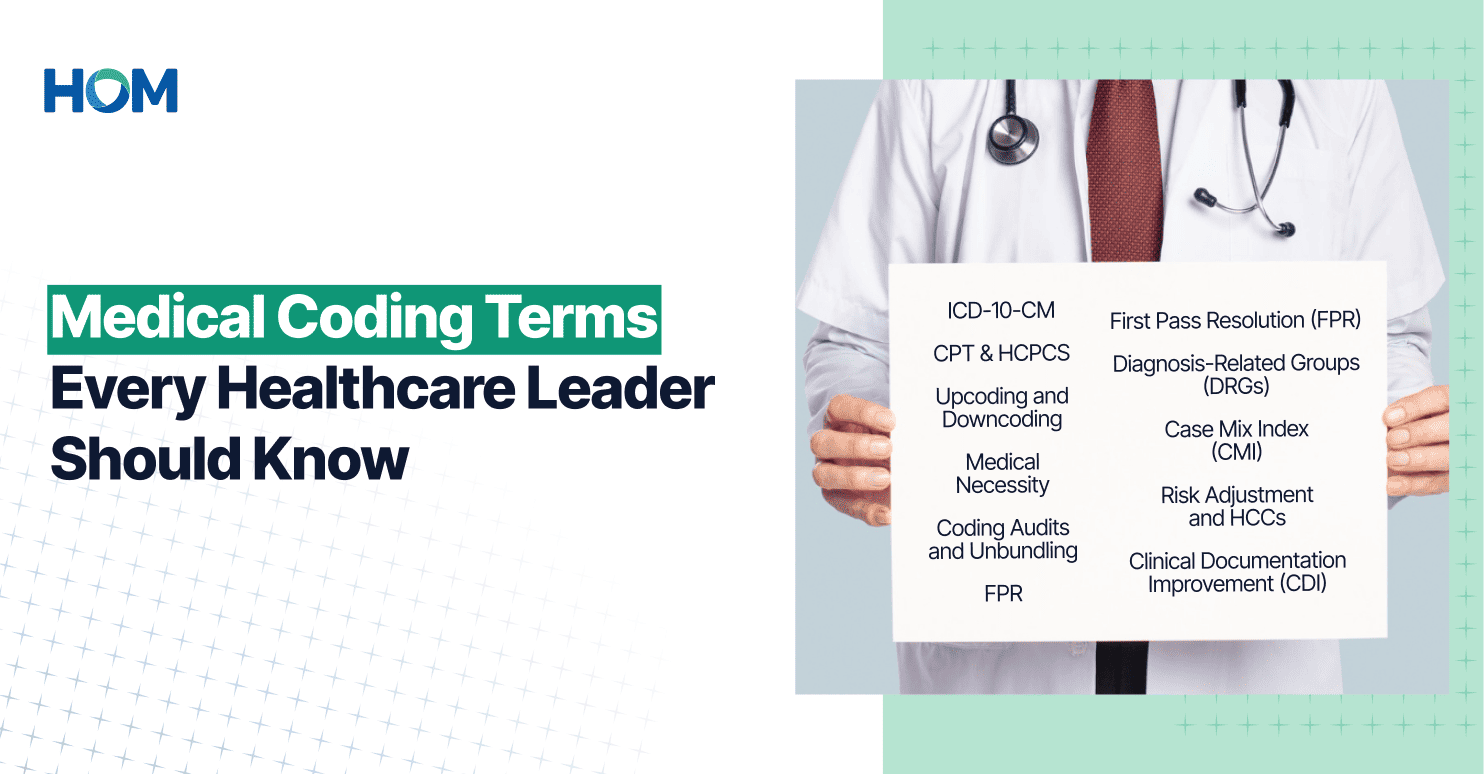
Medical Coding Terms Every Healthcare Leader Should Know
Key Takeaways:
- Knowledge of medical coding terms directly affect revenue, cash flow, and compliance exposure.
- Coding gaps often surface as denials, rework, and revenue leakage.
- FPR, CMI, and DRGs serve as early warning indicators that help leaders identify financial performance issues before they impact quarterly results.
Introduction
Medical coding often takes the back seat behind billing operations. But when your CFO asks why cash flow is lagging or your Compliance Officer flags audit risk, the answer often traces back to medical coding gaps that leadership teams don't have the language to address.
In the USA, 10-15% of hospital claims are initially rejected due to coding errors, adding to the administrative burden (25% of US hospital spending) and delayed cash flow (minimum 45 days for reappeal). Nearly 80% of medical bills contain at least one error, with inaccurate coding and documentation being a leading cause. Industry estimates show that coding-related revenue loss alone may amount to tens of billions annually and stretch accounts receivable timelines.
Despite these financial stakes, many leaders make financial decisions based on reports shaped by medical coding terms without complete visibility into the language behind them. Familiarity with them could help leaders interpret revenue data better, ask sharper questions during budget meetings, and build stronger RCM strategies.
This blog translates key medical coding terms into business impact language, not for coding managers, but for executives who need to ask the right questions when revenue drops, denials spike, or audit risks emerge.
Core Coding Terms that Directly Impact Your Financial Reports
These foundational terms determine how much your organization gets paid and how quickly claims move through the system and influence revenue outcomes:
ICD-10-CM
A single missing chronic condition code can cost your organization thousands of dollars annually per Medicare Advantage patient. That's the business impact of ICD-10-CM codes, which record patient diagnoses and serve as clinical justification for every service billed.
Payers rely on these diagnosis codes to assess medical necessity and claim validity. But the financial implications extend far beyond individual claims. Risk adjustment models use ICD-10-CM codes to calculate your patient population's expected costs, and reporting programs rely on these codes to measure performance.
Incomplete diagnosis coding creates a ripple effect across your organization. Your risk scores drop, quality metrics decline, and contract negotiations start from a weaker position because your data understates patient complexity.
CPT and HCPCS
CPT and HCPCS codes translate your services into dollars. These codes determine claim value and reimbursement amounts, making them direct drivers of revenue.
Here's what matters financially - these codes link directly to fee schedules and payer contracts. One wrong digit could change reimbursement.
Outdated codes trigger automatic denials. Missing codes lead to rework.
The relationship between diagnosis codes and procedure codes must make clinical sense. A payer won't reimburse a cardiac stress test if the only diagnosis code is diabetes without cardiac complications. Each mismatch delay revenue cycle by 30 to 45 days.
Coding Accuracy, Compliance, and Audit Risk Terms
Some medical coding terms represent legal exposure and financial risks. These deserve closer executive attention:
Upcoding and Downcoding
Upcoding refers to the practice of billing for a more complicated service than what the documentation justifies. Downcoding means billing below the actual service provided. Both practices carry significant financial consequences.
From a business perspective, upcoding poses a compliance risk with penalties starting at $10,000 per violation. Federal auditors actively search for patterns that indicate intentional upcoding.
Although downcoding may seem safer, it can be just as costly. Conservative coding and downcoding can erode roughly 5-10% or more of revenue, and in some organizations, up to 20-30% of potential reimbursement. Therefore, leaders should watch for unusual shifts in coding levels and sudden payer scrutiny. These patterns often precede formal audits.
Medical Necessity
Medical necessity links diagnosis, service, and documentation. Payers can deny the claim without this alignment. This issue contributes to nearly two-thirds of all claim denials. The financial repercussions compound because these denials require thorough review and appeals.
It is critical for leaders to watch denial reports for medical necessity patterns. Repeated denials for specific procedure-diagnosis combinations may indicate gaps in documentation or an additional need for coding training.
Coding Audits and Unbundling
Coding audits come in two forms: internal audits that help catch errors before payers do, and external audits that are conducted by government agencies or commercial payers. Organizations that conduct quarterly coding audits can reduce improper payments significantly.
Industry best practice suggests quarterly internal audits, with monthly spot-checks for high-risk specialties or new physicians.
External audits, however, have financial consequences as Recovery Audit Contractors have the authority to demand repayment for claims filed up to three years earlier.
Unbundling occurs when services billed together are separated incorrectly. This practice doesn’t just trigger audit flags, but signals payers that your coding practices need closer scrutiny. Leaders should review audit outcomes as indicators of process strength.
Claim Denials and Rejection Terms
While denials and rejections may sound similar, they impact cash flow in distinct ways.
Rejection indicates that payers have not accepted the claim for processing, often due to invalid codes or missing patient information. In contrast, denials occur when payers review the claim but decide to refuse payment, usually because of clinical or coverage disputes. This can take 45 to 60 days to resolve.
Financially, rejections postpone revenue, whereas denials can result in permanent losses. Leaders should track denial categories tied to coding, instead of volumes. Patterns can reveal whether revenue loss stems from preventable coding errors.
First Pass Resolution (FPR)
First Pass Resolution (FPR) tracks the percentage of claims paid without needing any follow-up. It is a strong indicator of coding and documentation quality. A lower FPR (below 95%) may need more staff time to address rework, as each percentage point directly translates to heavy financial loss.
Therefore, it’s essential to monitor FPR by both payer and provider. For example, if one physician has an FPR of 78% while the group's average is 94%, it indicates a correctable issue that could save thousands monthly.
When you spot this pattern, the issue typically traces to documentation habits, specialty-specific coding complexity, or lack of coding education rather than physician performance. Targeted training can close these gaps within 60 days
Diagnosis-Related Groups (DRGs)
Diagnosis-Related Groups (DRGs) are mainly used for inpatient hospital billing. They group diagnosis codes, procedures performed, patient age, and complications. Incorrect diagnosis codes or a lack of documentation concerning complications can downgrade a case to a lower-paying DRG.
For instance, the payment difference between DRG 291 and DRG 292 for heart failure can exceed $3,000 per case. Understanding this term helps interpret inpatient margins and length-of-stay metrics.
Case Mix Index (CMI)
CMI reflects the average complexity of treated patients and depends heavily on accurate coding. This is because a higher CMI indicates sicker patients who have greater treatment costs. Medicare increases payments for hospitals with a higher CMI.
A declining CMI may not always mean healthier patients; it may mean missed documentation or coding gaps. Even a 0.1 difference in CMI can result in hundreds of thousands of dollars in annual Medicare revenue for a mid-sized hospital.
When CMI drops, don't assume your patient population changed. Audit coding practices and documentation completeness before adjusting financial projections.
Risk Adjustment and HCCs
Risk adjustment ensures reimbursement for Medicare Advantage and Affordable Care Act plans matches patient complexity. Here, Hierarchical Condition Categories (HCCs) determine future payments. Payers receive higher capitation payments for patients with documented chronic conditions.
Incomplete or missing HCC capture can reduce expected revenue and distort population health data. Over time, this could skew financial planning.
The key opportunity here is that thorough HCC capture can enhance risk-adjusted revenue without adding patient volume, procedures, or clinical staff. It's pure margin improvement through documentation accuracy.
Clinical Documentation Improvement (CDI)
CDI programs focus on training physicians to provide more detailed and accurate documentation of patient conditions.
Strong CDI practices improve coding accuracy and audit readiness, and help mitigate compliance risks. For every dollar invested in CDI programs, organizations see three to five dollars in return through improved coding accuracy, reduced denials, and stronger risk adjustment.
In contrast, weak CDI programs could lead to queries, delays, and missed revenue.
Leaders can influence CDI success through resourcing, alignment, and accountability.
These medical coding terms represent more than just vocabulary. They're the operational levers that determine whether your revenue cycle runs efficiently or leaks millions annually.
The challenge most healthcare leaders face isn't understanding individual terms; it's implementing the processes and oversight needed to maintain accuracy across thousands of claims, dozens of physicians, and multiple specialties.
HOM can help here with tailored RCM programs across 15+ medical specialties. Having served over 300 healthcare providers and payers worldwide in the past close to 10 years, we’ve delivered measurable results, including a up to 35% reduction in coding-related denials. Our 24-hour turnaround time supports faster cash flow without compromising accuracy.
HOM’s end-to-end RCM services include comprehensive coding audits and practices, ongoing education, and real-time claim scrubbing using AI. You may schedule a free coding audit to understand exactly where coding errors are affecting your revenue.
FAQs
1. Why should executives focus on Medical Coding Terms?
Medical coding terms shape revenue reports, denial trends, and audit risk. Without clarity, leaders may misinterpret performance data and make costly decisions.
2. Which coding terms most affect financial outcomes?
ICD-10-CM, CPT, medical necessity, denials, CMI, and risk adjustment have the strongest impact on reimbursement and forecasting.
3. What coding metrics should CFOs monitor regularly?
Track clean claim rate, first pass resolution rate, denial rate by reason code, and accounts receivable aging. Monitor coding audit results and compliance scores. These metrics predict revenue cycle performance and identify problems before they become crises affecting quarterly results.


Bring a change to your Healthcare Operations
A partnership with HOM gives you an inherent:

Adherence towards federal, state, and organizational compliances, as well as safeguarding patient data.
Sense of ownership and commitment towards providing value.
Focus on speed, accuracy, efficiency, and optimal outcomes.
Sense of security and transparency through periodic reporting and actionable insights.
Connect with our experts for a quick analysis and possibilities.


